
Backtesting + Time Machine = A Gazillion Dollars
The first in (probably) many posts about backtesting

I’m running a bit behind on the writing lately because I’ve been doing a lot of, well, what we’re going to talk about today…
An easy way to cut off online trading hucksters at the knees: Ask them for a backtest that proves their work. If they’re frauds, you’ll hear crickets.
If you’re not already a trader, you probably have no idea what the hell a backtest is. (Every time I tell a non-trader I spend most of my day backtesting, they look at me like I have two heads.)
Backtesting is a critical skill for systematic trading, so I’m going to spend a few blog posts on it.
The boring definition: A backtest is a simulation that applies a trading strategy’s rules to historical market data to calculate what the performance would have been if you had executed that strategy during that time period.
In other words, if I had a time machine, what trades would have made me a gazillion dollars?

There’s an obvious flaw in that. As anyone who’s ever read the fine print on any financial prospectus can tell you: “Past performance does not guarantee future results.”
That’s true. But a backtest can definitely tell you what totally sucks and does not work.
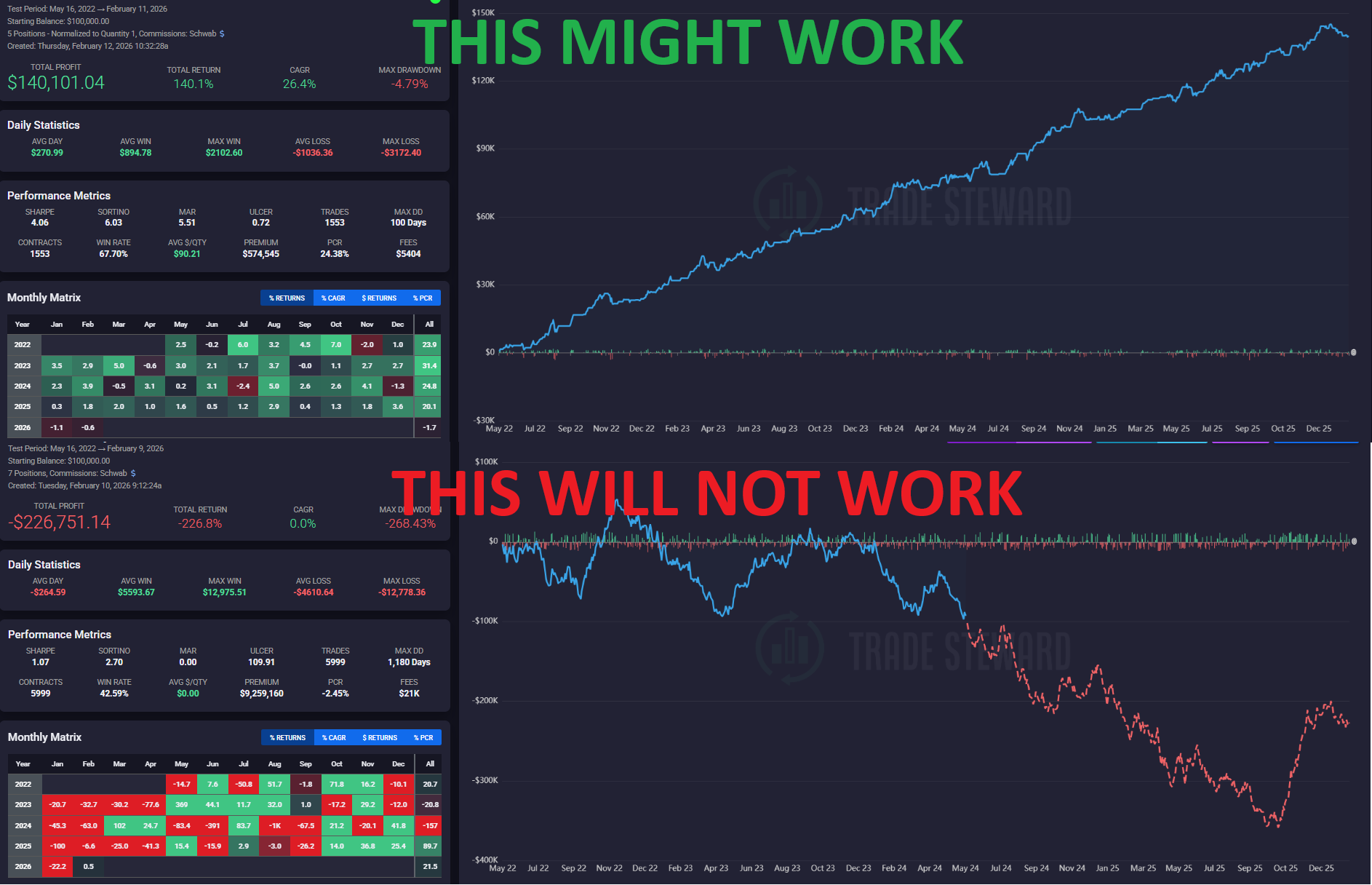
It can also tell you what only worked for a short period of time. And how likely you are to blow up.
Before you think “there’s no way I can do this,” keep in mind: Software does the heavy lifting. It takes your strategy inputs (structure, entry signals, timing, sizing), runs them through historical data, simulates execution (fills, commissions, slippage), and spits out performance metrics (returns, drawdowns, Sharpe ratio, etc).
Then it’s just a matter of coming up with ideas. Finding things that work. Throwing out anything that doesn’t. So easy, a former recruiter could do it.
Of course, there are a ton of ways backtesting can go wrong: overfitting, survivorship bias, ignoring transaction costs, insufficient sample sizes, unrealistic execution assumptions, data quality issues, etc. Which, thankfully, gives me an endless number of things to write about in the future…
But if you can find a successful strategy that avoids those types of pitfalls, that’s where you can make money in a reasonably-reliable-and-not-completely-luck-based way. (See obligatory disclaimer below.)
Back to the online hucksters. YouTube, Instagram, and TikTok are flooded with people pumping out trading advice. A lot of it even sounds plausible and is based on trading fundamentals.
Yet the devil is in the details. Financial content creators don’t even have to be good at trading to make money. They can simply charge you for access to their community or just make money off the social engagement. Even if they claim that they made some crazy return for a year or two, and it’s actually true, that doesn’t mean they did it in a way that’s actually repeatable and eliminates blow-up risk.
Anyone who can’t show the receipts isn’t worth listening to. Creating those receipts via backtesting is the real work in systematic trading.
More to come…
Disclaimer: This is educational content, not financial advice. I’m not a registered financial advisor. Trading options involves substantial risk and isn’t suitable for everyone. You can lose more than your initial investment. Do your own due diligence and never trade with money you can’t afford to lose.